
Tax preparation in Concord for individuals and businesses
For Concord personal tax preparation, name the year, income sources and federal, California and other-state returns before choosing a service. Ask whether an original, overdue or amended return is accepted, what records are needed and whether any bookkeeping or statement reconciliation costs extra. Neither a complex business nor a minimum income is a condition of defining the filing work.
A business proposal should identify the actual tax classification, ownership, period and records. Agree who prepares the entity return, who provides final information to the owner's personal preparer and who resolves missing or conflicting figures. Annual filing, estimates and later agency correspondence should have stated boundaries.
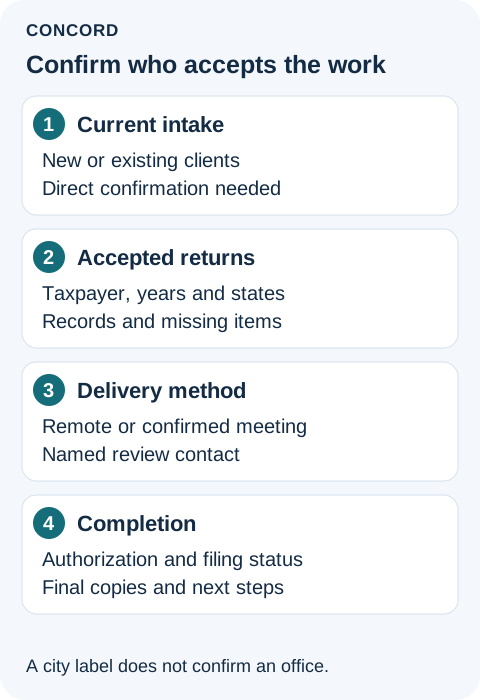
Confirm current intake directly with the actual person accepting the assignment. A public service page may describe work offered to existing clients without accepting new ones. Likewise, a search result or city label does not confirm meeting premises. Agree the delivery method, review contact and completion timetable, whether work is remote or uses a confirmed appointment location.
Choose the filing service that fits your return
Compare paid preparation with any official filing option that fits the entire return. CalFile is a California state-return service, with year-specific eligibility and form restrictions; it does not complete federal filing. Business or rental activity needs particular care when checking its qualifications. The California individual preparation guide explains the supported-year and eligibility limits, including the dated 2025 rules. Do not assume a new filing season is already supported.
For paid help in Concord, compare how records, questions and draft review will be handled, whether remotely or through an agreed meeting. Use the California credential checks for the professional's actual category and authorization. An advertised service is not confirmation of experience with your return or current availability.
Know when the filing work is complete
Agree a secure document route and a list of missing information. Identify who prepares and reviews the return, how you check the draft and authorize submission, and how each federal and state filing status is reported. Ask who handles a rejection and what remains your responsibility. Keep final copies and payment instructions; submitting a return and paying a balance are separate steps. Later amendments, notices and new planning questions should have an explicit scope.
For company-specific filing responsibilities, use the California business preparation guide. If the immediate problem is an agency letter, the California notice-help guide separates the agency, period, deadline and response assignment.
Business tax help in Concord: confirm acceptance and scope
Finding a Concord tax-planning page is a starting point. Before relying on a professional for a business decision, establish whether they can consider the new assignment, what they would review and when the work could realistically be done. A service menu does not answer those questions on its own.
The work needed determines the engagement. Ordinary personal or business preparation can be appropriate without an income minimum or an additional planning project. Keep company sales, profit, asset values and personal income distinct when describing the assignment.
Check whether the proposed work can be accepted
Christopher Koch's public service page provides a useful example of the distinction. It lists planning, preparation, estimated-payment vouchers and representation or support for existing clients. In the same page reviewed on October 30, 2026, its new-client section said that new clients were not being taken.[1]
That is a dated public statement, not an ongoing availability check. It illustrates why an owner should confirm intake directly instead of assuming a planning page means the firm can accept a new relationship. The same caution applies to a new piece of work with an existing provider: ask whether the actual assignment, taxpayers and timing are accepted.
Explain your decision date and what remains open. If the professional needs records or specialist input before deciding whether to take the work, establish that first. Submitting a contact form is not the same as accepting an engagement or confirming a review appointment.
Compare Concord service descriptions without assuming a package
Other public descriptions help frame the scope enquiry. These are researched examples, not FSI partners, recommendations or independently verified credentials, performance or capacity.
David Volkar Accountancy describes personalized tax advice, preparation for several taxpayer types and accounting services.[2] Ask which owner decision a proposed review would address, which records are needed and what the professional would provide beyond preparing the agreed returns.
Fortune & Fortune's planning page describes year-round work and a range of strategy topics.[3] Those topics do not establish that a particular approach applies to your circumstances. Ask for the review needed to reach an actual conclusion, rather than compare firms by the number of strategies listed.
The Fortune page reviewed also contained different contact blocks: one listed Concord and the footer listed Walnut Creek.[3] This guide does not determine which premises are current. Confirm where and how a proposed engagement would be delivered instead of relying on a search title, address or city reference alone.
The useful comparison therefore has two parts: can the provider consider the work, and does the proposed scope answer your question? Neither a local address nor a broad planning description settles both.
Put the current decision into the initial enquiry
Give the candidate a concise ownership and decision summary. Identify the operating business, other entities involved, the owners and any advisers already working on the matter. State what you are considering and what information is still uncertain.
For example, an owner may be deciding whether to make a material operating commitment while the company's annual return work is already with another firm. Before expecting the new candidate to advise, ask which current facts it needs, whether it will coordinate with the existing preparer and which owner and entity positions it will review. This is an illustrative scope question, not a recommendation about the commitment or its tax treatment.
Ask whether the initial review is a separate assignment from annual preparation. If the candidate will only evaluate part of the question, identify what remains with another professional. A defined limitation can be more useful than a vague promise to handle everything.
Share sensitive records through an agreed secure process. A short initial description can identify the question without putting returns, detailed financial records or personal information into a public message.
Clarify what happens after a planning discussion
Before agreeing to the work, ask what will remain after the meeting. You should understand the question reviewed, the facts and assumptions used, material uncertainties and the next action. Establish whether the professional will explain the result in writing and which follow-up is included.
Then ask who carries out any agreed action. A firm may analyze a decision while payroll, legal documentation, bookkeeping or another part is handled elsewhere. Identify the handoff and who confirms that the necessary information has reached the right person.
Clarify fees and updates at the same time. Does the proposal cover the defined review only, later implementation support or recurring reassessment? What happens if new information changes the question? A year-round service label does not establish that every new event is included in the original fee.
These questions make the proposal comparable without requiring an adviser to promise a saving. A useful review may explain why an option does not fit, identify missing evidence or recommend a different specialist. The result should help the owner make a better-informed decision, rather than simply add another strategy name to a list.
Verify the professional and use the correct enquiry route
The IRS explains practitioners' qualifications and representation rights, including the unlimited IRS representation rights of CPAs, enrolled agents and attorneys.[4] Those rights do not establish experience with every business model or a provider's current capacity.
Use the California Board of Accountancy's lookup for the correct CPA or firm identity and authorization.[5] For an enrolled agent, follow the IRS status-verification instructions and Office of Enrollment request route.[6] Then ask who will perform and review the particular work you need.
Related information: California business tax planning resource.
Sources
- Christopher Koch: services, existing/new-client statements checked October 30, 2026; confirm current intake directly.
- David Volkar Accountancy, public services checked October 30, 2026.
- Fortune & Fortune: planning, readable service and conflicting contact descriptions reviewed October 30, 2026; current premises not independently verified.
- IRS: preparer credentials and qualifications.
- California Board of Accountancy: license search information.
- IRS: verify enrolled-agent status.